Tuesday, 16 June 2009

The Call of the New


Two new things this week: a new set of rules for my SYW gaming and a new terrain mat.

First, the rules. These were the new set from Crusader Publishing; Rank and File: Horse and Musket Rules 1740-1900. The Crusader Publishing website (http://www.crusaderpublishing.com) allows you to get a good idea of the nature of the rules before buying, which is a thoroughly sensible idea and should be more widely adopted. I recall that the availability of a stripped down set of the Blitzkrieg Commander rules in PDF form (called Blitzkrieg Commander Lite) was instrumental in getting me to buy the full Blitzkrieg Commander ruleset a few years ago.

Rank and File seemed to be my kind of thing: designed to be genuinely simple and fast play, and contained in a manageably sized and well produced rulebook. The price of £16.50 including p&p seemed reasonable. They arrived within a week and so far I have read them through a few times and played one short solo game. They seem to do exactly what it says on the tin.

The rulebook is produced to a very high standard, being a 67 page full colour production on glossy paper with card covers. There is very little black and white here, and plenty of eye candy. This is perhaps one of the few criticisms I would offer: the high quality photos might have been better employed as illustrations of how the rules work rather than being mostly just nice to look at. However, explanation of the rules is thorough and generally straightforward, and includes some diagrams to clarify certain points as well as a 3 turn extended example which provides a solid idea of how gameplay proceeds. The rules fit my theory of a truly simple set: you can get a good sense of how they work in a single read through.

You won't find any strikingly new concepts here, but the rules are obviously designed to produce fast and eventful games. Instrumental in this are the generous moves, the fairly quick and deadly morale system and the generally simple mechanisms. There is no order system in the core rules and command and control is basic, which is fine by me. There are a fair number of optional rules which you can add in for more 'realism': at a first look I am quite happy with the core rules and am not particularly tempted by the extras.

The introduction states that the rules were 'designed so that a fairly large game can be set up and played to a conclusion within an evening'. Of course, what you consider a 'fairly large game' might vary, but I am aiming to raise forces of maybe 200 infantry, 50 cavalry and 4 to 6 guns per side, organised in units of around 8 to 10 cavalry and 20 infantry each. I think these rules will allow me to get a game with these forces played in around 3 hours quite easily. I would say these rules are definitely simpler than Minden Rose, and much simpler than Die Kriegskunst. They are perhaps a little more complex than the rules I have been developing myself which can be found on this blog, but I have no hesitation in saying they are much better, and my own little project will probably now cease development.

The fairly lengthy historical period covered is coped with by providing period specific tweaks for three time divisions: 1740-1792, 1792-1848, and 1848-1900. These tweaks (or 'period specific rules') are undemanding but sensible and take up only a page each.

What you won't find in these rules are army lists or detailed set up rules for terrain and scenarios. For myself, I can easily do without both. If you know your period, or are prepared to do a little research and reading (and surely the latter is part and parcel of wargaming), who needs army lists? And only a complete newcomer to wargaming will be phased by the absence of instructions on how to set up a battle. So, you provide your own armies, organised how you think they should be organised, and you devise your own scenarios. Suits me, and it saves many pages of extra rules.

I should finally say that the rules aim to accommodate all figure scales and basing conventions, and a variety of levels of play: that unit of six bases might have 4 28mm infantry figures per base and represent a battalion, or a larger number of smaller figures on it and represent a brigade (or vice versa, if you see what I mean). However, for 28mm figures the basing conventions and units sizes used in the examples and photos are almost identical to those of Minden Rose and Die Kriegskunst.

In summary, these may well turn out to be my new rules of choice for SYW. I recommend you look into them. And if you have any questions, there's an active Yahoo group called Crusaderminis where the author (Mark Sims) is available.

* * *

My second new thing is the purchase of a Citadel (i.e. Games Workshop) gaming mat. Easily available, and a snip at £14.70 for a 6'x4' mat, but the reasons I decided to buy it go back a fair way.

During my visits to shows over recent years I have noticed one thing in particular: for my money, a lighter coloured green as a basic terrain colour made better looking games. In particular the lighter shades of tile or mat showed off the figures better. Those games with a more drab green base colour looked rather, well, drab. My own TSS tiles have served me very well over nearly twenty years, and I would recommend them to anyone. But I began to wish they were flocked in a brighter shade of green.

So my search for possible alternatives began. I certainly wasn't going to model a new set of terrain tiles for myself! The idea of spraying the TSS tiles a lighter shade was kicked around, but I have a bad feeling commercial spray paints would react with the expanded foam, and I had no great hopes of making a decent job of the spraying even if I could find the right colour. So it came down to some sort of terrain mat. I looked around a number of local fabric shops seeking a nice bit of green cloth that would do the job but the right shade eluded me. The Terrain Mat people seemed to produce mats that had a reputation for being easily damaged, and the colour was a bit too olive. Mat-O-War were a favourite for a while but they are widely reported to be rather stiff. This would mean I would need to find a new set of matching hills to put on top of them: more expense. Ditto the mats from The Terrain Guy in the US. These had a mottled appearance on the website which I didn't really want and I would have to buy the matching hills.

The GW mats were a genuine, flexible cloth, so I could create hills by placing my current TSS hill contours under the mat. This is a technique I have been reading about since Donald Featherstone mentioned it in his 1962 book Wargames: yet I have never used it till now. I had also seen the mats in use at the WMMS show this year, and they were widely reported to be durable and well made. The final sell on the GW mat actually came via the Rank and File rules. Most of the photos in the rulebook use the GW mat, which is a nice green colour significantly brighter than my present tiles.

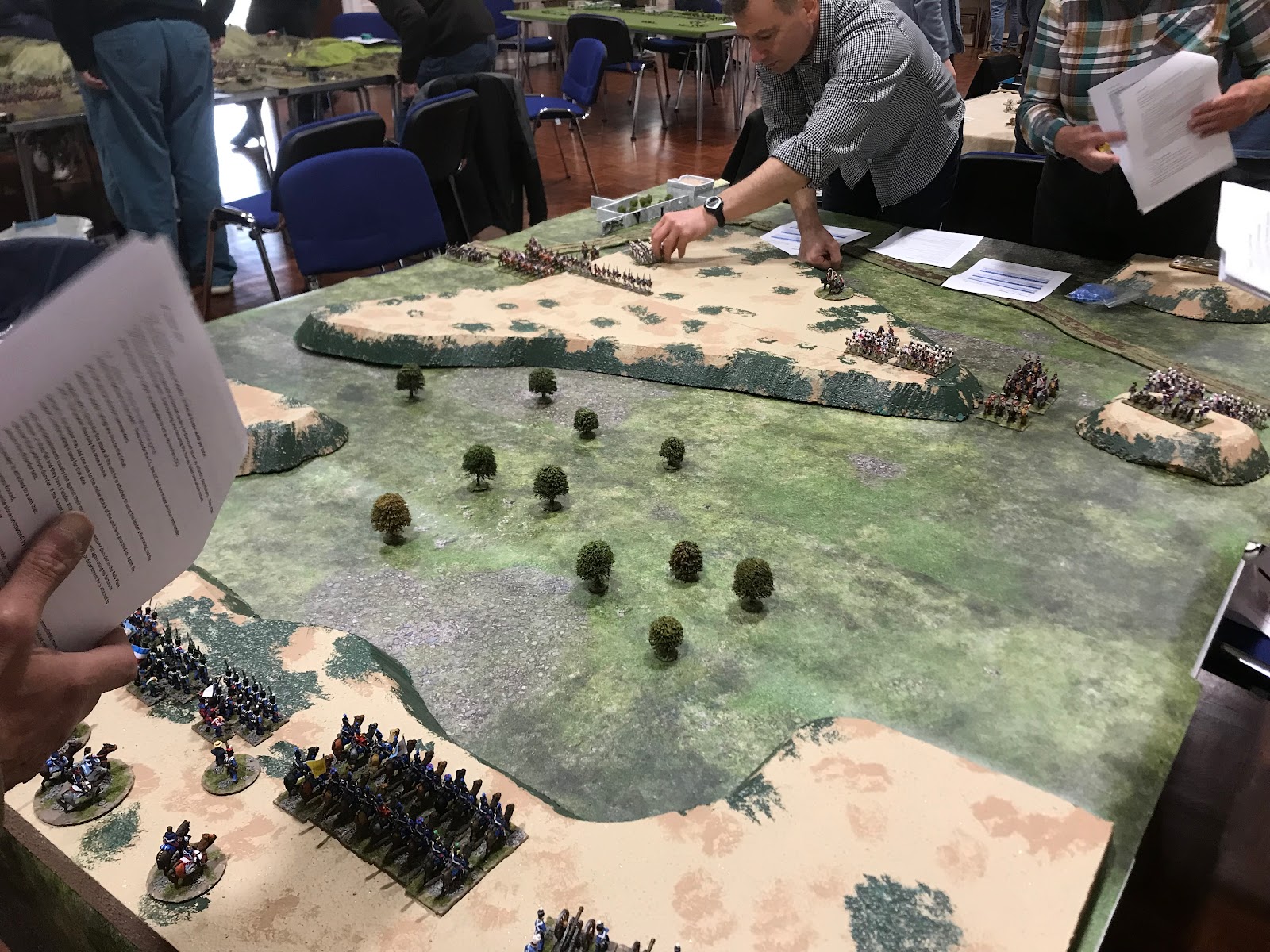
The results you see below. The mats are indeed well made, and the packing creases are easily ironed out. They lay well and don't seem to slip much. The hills I created are not really obvious in the shots: the Prussian infantry on the left are on one hill, and the Prussian guns on the right are on the other. The photos were actually taken during my solo run through of the Rank and File rules. The table was only quickly set up and will probably look even better when properly 'dressed' in a bit more detail. Generally, I am pleased with the new look. The only problem now is that I have to get some new rivers if I want to use them with the mat: my current rivers are produced by using TSS river tiles. The Flames of War river sections on sale for £45 seem a good option, but funds are lacking at the moment!


One thing I will have to look into is why my photos make the green on my terrain look less green than it really is. My TSS tiles often look a khaki shade in the photos, and the new mat looks a lot less green than it really is. If anyone knows why this may be, I would be interested to know. For the moment, I will search out a high wattage daylight simulation bulb for the light in the dining room where my games take place. Perhaps that will help.

As usual, comments encouraged. Go on, surprise yourself! Wishing you good wargaming until the next instalment.

P.S. Some excellent photos are now available of an ACW game using both the Rank and File rules and a table laid out with GW game mats in the same way as shown above. See the Crusader Publishing website at crusaderpublishing.com then look up Battle Reports.

Thursday, 11 June 2009

Austrians in Rout


I have recently ordered a set of the new Rank and File rules from Crusader Publishing. However, they are not here yet so last night's game was played with Minden Rose. Not a bad thing: I haven't had a go with these rules for a while and they produced an excellent battle. Just for once I decided to have a straight encounter punch-up, rather than work out a clever scenario. Below are a few pictures: I won't go into too much detail, but the Austrians (me) were soundly beaten. Cavalry on both flanks fell back then routed, and at the end of the game the infantry in the centre also routed decisively under a hail of Prussian fire.
Tipple of the night was a very pleasant Rioja.

Light infantry occupy the town, which they will hold throughout the game.

Infantry faces off in the centre. The Prussians put everything in a single line, which seemed to work. This was the age of linear warfare after all!

Another view of the centre. No, those aren't Bavarians: a trick of the light in the camera has somehow turned the white Austrian coats to pale blue! Hungarian columns in background.

Destination disaster: the Austrian left flank cavalry are under pressure.

Meanhile the light infantry continue to hold out: mainly because the
Prussians decided not to charge in.

Prussian grenadiers in the centre brace themselves for an Austrian volley.

Run away! In the final move Prussian firepower triumphs. Austrian infantry routs and the Prussians pursue. The C-in-C (centre, with black counter indicating he is inferior) is powerless to stop the rot

And on the right flank the remaining Austrian cavalry are being ushered back over their baseline. The Austrian officer (inferior again!) seems to hang his head in shame, whilst the Prussian officer urges his men on

Light infantry still there in the last move!

Tuesday, 19 May 2009

Polish Counter-Attack


It's been quite a few months since my 1939 Polish-German forces had an outing, so I decided to give them a go last night. I also decided to make it a reasonably big game (by my standards) to see how far we could get. I won't overdo the detail of how the game progressed, but present you with some captioned photos and some general points that the game raised in my own mind.

The game was a fictional scenario. It imagined a bridgehead across a river held by elements of a German Light Division. These elements are counter-attacked by a strong Polish force trying to eliminate the bridgehead and recapture the two bridges the Germans have used. German reinforcements are on the way. The game used a 6' x 6' table, the miniatures being 15mm size. Details of the forces were as follows:

Poles

CO (CV9)

Infantry Battalion x 2
HQ (CV7), 8 infantry units, 2 mg units, 1 37mm ATG+tow

Cavalry Regiment
HQ (CV8), 8 cavalry units, 2 mg units, 1 75mm unit+horse tow, 1 Wz34 (recce)

Armoured Battalion
HQ (CV8), 5 7tp (37mm), 1 7tp (mg)

Recce Battalion
HQ (CV8), 2 TKS (mg), 1 TKS (20mm), 3 m/c units

Artillery Battalion
FAO (CV7), 3 75mm artillery units, 6 assets

Artillery Battalion
FAO (CV7), 3 100mm artillery units, 6 assets

Karas Flights
2 Karas units, 2 assets each

Points: 2030 Breakpoint 23 (25% = 12)


Deployment/Victory Conditions.
All units use static deployment on baseline from move 1. Capture both bridges for major victory. Capture one for minor victory.

Germans

Initial Forces

Infantry Battalion
HQ (CV9), 6 infantry units, 2 mg units, 1 mortar unit, 1 37mm ATG+tow

Recce Battalion
HQ (CV9), 1 Sdkfz 231, 1 Sdkfz 222, 1 Sdkfz 221, 2 m/c units, 2 cavalry units, 1 mg unit+truck

Artillery Battalion
FAO (CV8), 3 105mm artillery units.

Reinforcements

Light Panzer Battalion
CO (CV10), 3 PzI, 3 PzII

Motorcycle Battalion
HQ (CV9), 6 m/c units, 2 mg units+2 trucks, 1 37mm ATG+tow

Stuka Staffel
FAC (CV7), 1 Stuka unit

Points: 1580 Breakpoint 17

Deployment/Victory Conditions.
Initial forces deploy dug in (except vehicles) anywhere in own half of board. Reinforcements use mobile deployment from baseline from move 4. Break Polish battlegroup for major victory. Cause 25% casualties for minor victory.

Notes.
Making up a Polish battlegroup of sufficient striking power to have a chance at a successful attack during an evening's wargaming usually involves creating a fairly non-historical force. This game is no exception, as Polish experts will be able to tell.
The recce formations on both sides were treated as fighting units. The only unit which counted as 'recce' for the purposes of the rules was the armoured car with the Polish cavalry. The Polish cavalry, recce and tank formations were all given an extra point to their CV (representing their 'elite' status). Even so, the Polish attackers were only about a third stronger in points than the Germans, although not all German forces would be present at game start. All artillery was off table except the 75mm unit attached to the cavalry. This is how the game panned out:

This gives you an idea of the layout. The first move was a dream for the Polish player (myself). The cavalry leapt ahead on the right flank (four orders) and there were multiple orders for all formations, except the armour who received only one. Ah well, they would soon catch up, I thought. Wrong! The Germans had their infantry nicely dug in on one flank, with the recce waiting behind the village.

Massed Polish infantry on move 1.

Cavalry race ahead on the opposite Polish flank.
The slower MG carts and 75mm gun have fallen behind a bit.
The CO looks on from the hill.

An unusual encounter on move 2: recce vs. recce. The German armoured
cars provide cover whilst the rest of their formation rushes to redeploy to
the bridge on the German left flank. German FAO in village.

A nice bit of smoke intended to mask any German units in the village
from interfering with the advance of Polish mobile units on the
Polish right flank. This is move 2.

Poland's shame: or, Put that clipboard down and get moving!
Move 3 and the tanks haven't budged. In the distance the cavalry are
desperate for their support to break through to the bridge.

Meanwhile the Germans on the other flank easily hold the attackers.
They had 3 or 4 orders each move after the first, blasting the Poles with
fire and causing heavy casualties as well as numerous suppressions.

And on move 4 they were joined by the Motorcycle Battalion
advancing in fine style. This flank was never threatened: a comparison with the earlier photo will show that the battalion commander has dismissed his command car and broken out the picnic table.

The Polish tanks finally move but too late. The German recce have formed
a blocking position and the Polish cavalry have been stopped.
The Polish recce formation has also been stalemated.

Move 4 and the German tanks arrive and cross the bridge on the
German left flank. No way through here for the Poles either. Game over!

After the battle.
We had an interesting and pleasurable three-and-a-bit hours of gaming with this scenario, but it raised some interesting points for me.

Firstly, although we only had time for 4 moves, it was quite obvious that the Poles couldn't win once the German reinforcements had arrived. And we had had so many multiple orders that 4 moves of BKC was as good as 12 moves of a more traditionally structured set of rules.

Was the scenario properly balanced? It was still a tall order for the Poles. Nevertheless, if the tanks had had the same luck as the cavalry, it could have been a very close game. Perhaps next time I would motorise one of the Polish infantry battalions, and have the Polish start line 30cm in rather than the standard 20cm, to make the task that little bit more achievable. Another 'fix' might be to put back the arrival of the German reinforcements by a move.

My tactics as the Polish player left something to be desired. I used the CO's re-roll ability a couple of times (to little effect), but I should have done the obvious and placed the tanks directly under the CO's command from move 2. The attacking infantry battalions were easily seen off: the one nearest the centre should have moved out wider and attacked the Germans in flank, or gone through the village and straight for the bridge. But there was probably not enough time for an infantry unit on foot to complete such a manouevre. I also have the feeling I didn't make full use of the quite powerful Polish artillery.

I have two possible explanations for my poor performance. One is the bottle of Chilean Chiraz that Paul brought over: shades of last month's Belgian beer! The name on the bottle was Casillero del Diablo: Cellar of the Devil. Yes, quite. But really I think the reason was that after spending about an hour setting up an evening game, maybe following a days work and cooking dinner, I tend to want to sit back and just enjoy watching the game unfold. Actually putting some thought into winning seems to go by the board. Does this happen to any of you? I also find not having a proper wargames room a real pain in the backside: setting up then taking down in the same session can sometimes seem a bit too much like work. Which makes another reason for relaxing and mentally sitting on your hands during the game.

D12 vs 2D6
Most BKC-ers who use the BKC forum will have come across this idea. The problem of how to get the most from low CV armies forms the content of quite a number of posts. One way is to use a D12 for command rolls rather than 2D6. This flattens the probability curve and improves the chances for a low CV army. For example, the chance of throwing 7 or less is the same with a D12 or 2 D6. However, you have a 42% chance of throwing 6 or less with 2D6, but a 50% chance of doing the same with a D12. For 5 or less, the difference is really significant: 28% with 2D6, 42% with a D12. At the other end of the scale, to throw a 9 or less with 2D6 is a probability of 83%, but 75% with a D12. Thus, in this game, the Germans would be penalised slightly and the Poles given a leg up, making things a bit more equal whilst retaining the uncertainty of the dice.

The chances of a 1 or 12 with a D12 (for a bonus or blunder) are higher (by three times) than the chances of a 2 or 12 with 2D6. You can either accept this or add a second throw with a single D6 to decide whether that was a real bonus/blunder or not.

We used a D12 in this game, and have used this technique quite a lot in the past. The effect is quite noticeable after two or three games. For games where the CVs are more equal (like the desert scenarios on this blog) we continue to use 2D6.

Well, that's all for now. Comments on all the above would be very welcome. I think there's still half a glass of that Chiraz about somewhere. Cheers!

Saturday, 16 May 2009

Four by Four


Well, painting has commenced again for my SYW forces. I have found a new method which prevents me from being overfaced by trying to paint too many figures at once: I just do 4 at a time. This means I can chip away at creating a unit in any spare twenty minutes or so, just doing one or two colours. I can usually do one group of 4 in a week with this method. Slow, but sure, and I find by doing a little but (fairly) often I can maintain my enthusiasm. As you can see, no advance on the usual basic style!


The unit being created is a battalion of the Bavarian Leib Regiment, to join my Austrian forces. This will give me the excuse to have a unit rated 'D' (for Minden Rose) or 'poor' (if using my own rules), so that I will be able to use a part of the rule sets I have not exploited before. This might be a bit unfair to the Bavarians, who may well have performed better if they had not been subjected to a textboook example of Frederick's oblique order at Leuthen, and also not had the retreat of the Wurttembergers as an example.

As you can see they are painted in the early war uniform, before black facings were adopted. I have also used the option of brown leather cross belts. Some sources indicate white for these, but brown makes a change amongst all that white. The standard bearer is a converted Spencer Smith advancing musketeer: the musket has been cut away and the hands drilled for a piano wire flag standard. The excellent flag is by Body's Banners, which are sold through Redoubt Enterprises.

I must say I find these Spencer Smiths a real problem. The castings are so poor, even basic detail such as where the coat ends and the trousers begin is difficult to establish. And check out those boxing glove hands! I salute those like Henry Hyde who have the skill and dedication to really make something of these figures - see the Spencer Smith website for photos of Henry's work. No black lining for me I'm afraid: I don't have the skill or the patience to create detail that isn't already there. It is only fair to remember that these figures are from the 1960s: actually it's great that they are still available for those who (rightly) value nostalgia and a certain elegance, especially en masse. Nevertheless, thank heavens I went for RSM figures for my armies!

Once a twenty figure unit of these is finished, a similar size unit of Freikorps will be painted, to provide the Prussian army with a battalion of similarly low grade troops.

Wednesday, 15 April 2009

Hafid Ridge

A10s of C Squadron, 2nd RTR, who would be the first British regiment
to attack at Hafid Ridge. Photo taken in April 1941, reproduced in
Tank Combat in North Africa, by Thomas Jentz.

Having chosen 'Swanning About' as the next Benghazi Handicap scenario to refight, I wanted to do the write up a bit differently. So I'm starting with some photos and explanation that might get you into the mood for the wargame. An overview of Operation Battleaxe and the Hafid Ridge action, which took place in June 1941, can easily be summoned online, or through any decent book on the campaign. Such an overview is not the purpose of this little introduction. Rather, I wanted to briefly explore some aspects of the battle which might illuminate the wargames scenario.

If you have already read my earlier post, 'Wargaming 2008', you will know that I do not really believe miniature wargames are capable of 'simulating' warfare in any meaningful way: I believe what we are doing is playing with toy soldiers. But that doesn't prevent us from doing some research into our period, especially when we are considering a refight of an historical battle.

Hafid Ridge is often cited as an example of the poor tactics of British armour during this period: a gung-ho charge against a well concealed line of German anti-tank guns. However, Frank Chadwick, author of Benghazi Handicap, makes it clear that this was not the whole story. Military historian Paddy Griffith has described the problems the British had in his book, World War II Desert Tactics.

'On Hafid Ridge the British would encounter a phenomenon that would become almost typical in subsequent battles. This was the allure of an enemy position that appeared to be only lightly defended, or occupied only by vulnerable soft-skinned vehicles. The temptation would be strong for British armour to charge in piecemeal and without careful preparation, leading to disastrous results when the enemy's 'vulnerable' trucks turned out to be accompanied by towed guns, some of which turned out to be very dangerous indeed to attacking tanks. On Hafid Ridge this problem was made worse by the complexities of the terrain, which turned out to consist of three successive ridges rather than just one; the Axis forces lurking behind the second and third caused all sorts of unexpected difficulties to the British armour that had successfully cleared the first.
This battle therefore stands as a classic early example of all those difficulties of reconnaissance, navigation and terrain analysis that proved such pitfalls for tacticians throughout the whole desert war.'

That there were problems with British tactics can hardly be disputed: the reference in the 6th RTR war diary to carrying out 'a good broadside shoot ... at speed' has been much quoted, and is hardly indicative of modern tactics. However, the British of 2nd RTR and 6th RTR did have a confusing and difficult situation to deal with, and were facing a well laid out defence. These factors should be borne in mind.

If you're not familiar with it already, the concept of the stutzpunkt is central to this action: a defensive position prepared for all-round defence which was intended to hold out even if outflanked, and consisting of anti-tank guns supported by infantry with (ideally) some artillery support in range as well. The literal translation of stutzpunkt is (I have found) a little awkward; but 'strongpoint' makes a good one word summary. Stutzpunkt 208 was one of 4 main stutzpunkte which anchored the German/Italian defence during Operation Battleaxe (the others were Stutzpunkte Halfaya, 206, and Qalala). There were 3 other supporting stutzpunkte in rearward 'backstop' positions. The idea of these positions was to delay and damage attacking forces whilst a panzer counter attack was prepared and launched. Some aspects of these positions are shown in the photos below:

This 88mm is dug in at Halfaya pass, but indicates what one of the 88mm positions on Hafid Ridge may well have looked like. The caption is well worth reading. The photo is taken from Thomas Jentz's invaluable Tank Combat in North Africa.

This is a pair of German gunpits, including one which seems to contain a 20mm flak gun as employed at Hafid Ridge. Once again, not actually Hafid Ridge (as far as I know) but indicative of how hard to spot such positions could be, even in open desert terrain. The image is from a New Zealand website, 'The Desert War'.

This photo (from lonesentry.com) is captioned as being of a 'dummy Axis gun position near Halfaya Pass'. If so, this shows how convincing such a position could be. The British concluded they had encountered dummy positions during the Hafid Ridge action, as the map below (once again from Jentz's book) shows. It is interesting to note how hard it is to work out the lie of the land from this map. Working out where the various ridges and dips were must have been a real problem for the British.


Jentz's book presents most of the primary evidence from both sides regarding Hafid Ridge. The extent to which there were dummy positions, or the extent to which the German defence was in any way 'mobile', is not really clear. It would seem survivors of the first line of positions may have fallen back behind the second ridge to join their comrades, which tempted the British on. The position was certainly arranged in depth, with many, possibly most, of the guns in dead ground between the ridges rather than actually on the ridges.

It is worth noting that both British tank regiments believed they were shelled by artillery at various times, and that the Hafid position contained a number of field guns. However, the order of battle for Stutzpunkt 208 did not include any artillery, just 20mm, 37mm, 50mm and 88mm AT guns. Probably fire from the 88s and the 75mm guns of German Panzer IVs was mistaken for artillery. Benghazi Handicap gives the Germans no on- or off-table artillery for this scenario. German reports indicate the British may have suffered some artillery fire from guns supporting Stutzpunkt 206 during their approach to contact.

I hope this introduction has given you a bit more feel for the circumstances of the battle, whether or not you possess Benghazi Handicap. Without further ado, this was my adaption of the scenario for BKC, using a 4' x 4' table with 6mm size models.


'Swanning About'
Hafid Ridge, June 15th 1941

British

Initial troops: 2nd RTR:

HQ (CV8), 3xA13, 2xA10, 2xA9

Reinforcements: 7th Armoured Brigade

Brigade HQ: CO (CV9)

6th RTR: HQ (CV8), 9xCrusader I

JAXO Column: HQ (CV8), FAO (CV7), 1xcarrier (recce), 3xinfantry units in 3 trucks, 1x2pdr portee, 1x25pdr unit (on or off table), 2 assets

Breakpoint: 11

German

Initial Troops: Stutzpunkt 208 Garrison

HQ (CV9), 1x88mm+tow, 1xSP20mm AA, 1x37mm+tow, 2xm/c(mg) units, 1xm/c unit

Reinforcements: 8th Panzer Regiment

A maximum of 3 battlegroups, formed at the player's discretion from:
CO(CV10), 2xHQ(CV9), 3xPzIII, 3xPzII, 2xPzIV, 3xm/c units, 1x50mm+tow, 1x37mm+tow

Breakpoint: 10

All German command units have a 25cm command distance increment.


Deployment
British initial troops deploy first up to 15cm from baseline. Then German initial forces deploy anywhere up to the centre of the table. All may be dug-in. They may also use hidden deployment, and are allowed 3 fighting units plus one command unit as dummies.
British reinforcements deploy up to 15cm from baseline during the command phase of move 3.
German reinforcements deploy up to 15cm from baseline during the command phase of move 5. Any German reinforcing battlegroup may also use flank deployment on either flank, in the first two thirds of the table.

Victory conditions
Both sides seek to break the opposing force, in order to control the area. Minor objective is to inflict 25% casualties, the major objective is to break the opposing battlegroup. No turn limit.

Notes
This battle was a natural for the optional 'Hidden Deployment' rules from the first edition of BKC. However, with such a small initial force, and considering the circumstances of the battle, I decided to allow dummy units for 50% of the force, plus a command unit as well. This should keep the British guessing for a couple of moves. Making 2nd RTR deploy first, before the German defence is positioned, is another attempt to give the defenders an edge. The 25cm command distance for the Germans was a small experiment to help them with both initial deployment and the mobile battle to follow. Perhaps this would help to represent their greater tactical flexibilty.
Both sides have the option of a separate brigade level CO operating solo and therefore able to intervene around the battlefield, rather than having the CO allocated to a fighting formation as in my Mechilli refight.
I also decided to go for simple victory conditions without objectives, as if this was a BKC 'encounter' battle.

The Wargame

I wasn't entirely happy with the look of the terrain. I had ordered 2 custom ridges from TSS but had asked for them to be too squared off at the ends. Silly me. The colour of flock used by the company has also subtly changed since I acquired my tiles, although the photo accentuates the colour difference. These two problems together resulted in the rather unconvincing rectangles you see above.
German baseline on the left (this direction is north), British on the right (south). The wadis in this game are 'shallow' in CDTOB terms, so they only count as dense terrain for BKC. The edge of a wadi will break LOS to units within the wadi.

This is the end of move 1. The A13 squadron of 2nd RTR have positioned themselves on the crest of the first ridge, and two tanks have been knocked out. This has meant that the real 20mm flak and 88mm gun have been revealed (if they were dummies they wouldn't have been able to fire), and the dummies removed.

Move 3, and 6th RTR and Jaxo column have arrived, deployed on the British right flank. 2nd RTR see no advantage in taking on the German gun line and so fall back and manoeuvre around the east end of the ridge as well. In this movement they were covered by smoke fired in move 2.

Next move finds the British huddling uncertainly in dead ground. Where will the German reserves arrive?

Half the German tanks with an HQ, plus the anti-tank guns and infantry under the CO, arrive on the German baseline to oppose the British tanks. A Crusader is knocked out. The other half of the German tanks were unfortunately ordered to arrive on the German right flank, well away from the action. Even more unfortunately, they will fail to arrive until move 8.

Move 6, and the high point of German success. The British fall back from the fire of German tanks and supporting anti-tank guns. 2nd RTR, however, start to sneak up on the Germans behind a rise on the east flank.

Moves 7 and 8 and the British start to use their advantage in tank numbers. 2nd RTR breast the rise and mince up the German tanks, supported by long range fire from the Crusaders. They are also in mg range of the German anti-tank guns and the 50mm is lost, whilst one 37mm is suppressed and the other knocked out. The infantry also make an impact, despite their small numbers, advancing forward and helping to engage the 37mm. German motorcyclists respond by moving forward to screen the German line. The 25pdr of Jaxo Column manages to suppress the 88mm during move 8. The Germans get some satisfaction with the destruction of 2 tanks from 2nd RTR, from a mixture of infantry anti-tank rifles, 20mm flak and 37mm fire.

The final positions. During move 9 the rest of the German tanks finally move across to help their comrades who are under severe pressure. 6th RTR wheels across the ridge and decisively defeats them in a flurry of opportunity fire, although half their number end up suppressed (indicated by the brown lichen placed behind them). A tactical mistake here: the Germans should have halted outside half 2pdr range, but within half 50mm/75mm range, which is possible with the ranges in BKC. This they failed to do, the German commander rashly advancing too far under the influence of Hoegaarden (Belgian white beer) provided by the British commander! 
Although 2nd RTR are nearly wiped out, mainly by fire from the 88mm, move 10 sees the Germans lose their next to last tank and go over their breakpoint by one. They need to roll 9 to continue, but an 11 sees them abandon the field. Probably a wise decision - they have lost 7 out of 8 tanks, as well as the 50mm, one 37mm and two of the motorcycle stands. British losses were 6 tanks from 2nd RTR and 1 from 6th RTR, with no loss amongst supporting arms. These losses mean the victory counts only as minor one.

Conclusion. 
A fun game, taking 3 hours to complete. Use of command re-rolls by the British CO, operating as a brigade commander (a house rule) were prominent in keeping the British moving. If the second German tank group had arrived on time and on the German left flank, it might all have been different. Although history was reversed, it was interesting that many features of the real battle manifested themselves. For example, 2nd RTR advanced, then backed off after initial casualties. There was also much skulking around behind and around rises and dead ground by both sides. The need for British tanks to close to mg range when attacking soft targets was a real problem for them. 
This has turned out to be a long post, but I hope you have enjoyed having something to get your teeth into!

Saturday, 4 April 2009

New GHQ Crusaders


To exploit the full possibilities of Benghazi Handicap I needed to acquire some later tanks than those I already had, having concentrated in my gaming so far on the period before Operation Battleaxe. So a couple of packs of GHQ Crusader 1s were ordered from Wargames Emporium of Sheffield (excellent service and good price). This gives me a perfect BKC regiment of 9 tanks plus one extra for the command stand. I have decided that ''Swanning About' looks good fun for my next battle, so these chaps will represent the 6th RTR in their first outing. The colour scheme may not be accurate: I chose a kind of generic Crusader scheme, using Humbrol 67 (panzer grey) over Humbrol 63 (sand). Tracks were painted brown (Humbrol 186) with a little highlighting in Light Stone (Humbrol 121).


I'm hoping to fight the scenario next week, so a battle report should follow in the not too distant future. I also want to fight the Battle of Bir el Gubi at some stage, so I will eventually need four more packs of these guys to create 3 Crusader regiments.

Also recently added are these two buildings from Timecast. I was looking for something that might represent Fort Capuzzo in a 'Rally Forward' refight (and of course stand in for other desert forts in the future). I was thinking at one stage of scratchbuilding something, but a representation of a real desert fort would probably take up too much room on the board: plus the additional problem that I couldn't be bothered with the hassle! What I needed was something that would give more of a sense of a desert fort than my current GHQ civilian buildings, and I think these models do the job. They are from the Middle Eastern and North African range, code 17/004. As usual with Timecast they are good quality castings, with just a few bubbles along the crenelations which were quickly filled.

Wandering off period, I also wanted to say that I have added a link to the Grand Duchy of Stollen blog. Can't imagine why I didn't add the link earlier. Stokes Schwartz has created a wonderfully inspiring Old School look for his SYW battles which is a must-see if you are into this period.

'Til next time!
Tuesday, 10 March 2009

SYW Rules


Seven Years War Wargames Rules

Inspired by Donald Featherstone

Introduction

Here is the promised rule set. The basic structure of Move-Fire-Melee is unchanged from the early Featherstone set from which they are developed. However, the rules have been extensively altered in the movement, melee and firing sections, but I think I can claim they are no more complex than the originals. The morale section is probably the least altered. A basic organisational and command system has been tacked on. The rules deal with Austrians and Prussians only. My own 'normal' units have 5 bases for line infantry, 4 bases for light infantry and cavalry, and artillery usually used as single bases, but occasionally 2 or 3 bases strong. 
All dice are D6 unless specified.

Of course, any comments (good or bad) are encouraged, and all questions will be answered. Should anybody actually fight a game with these rules, I demand to know the results!


Organisation and Command

These rules are designed for 25-30mm miniatures, mounted together on bases. Base sizes I use are roughly 40mm x 40mm for line and light infantry, 50mm x 50mm for cavalry and 60mm wide x deep enough for your guns for artillery. A base has 4 line infantry, 2 light infantry or 2 cavalry figures. Artillery bases have one gun model with crew figures, and represent ‘positional’ artillery of the 6-12pdr class.

A battalion of infantry or a regiment of cavalry should have between 4 and 6 bases. Artillery batteries should have between 1 and 4 bases. Standard formations for infantry and cavalry are line (all stands next to each other) or march column (all stands one behind the other). An ‘L’, ‘U’ or square shaped line may be formed to counter flank and rear threats, and an irregular line may adopted to conform with terrain features. Other formations are only allowed when necessary due to terrain restrictions. Light infantry may adopt any formation provided all bases touch each other. Any infantry or cavalry unit reduced by fighting to a single base is removed.

Battalions, regiments and batteries are the basic game units. They should be organised into brigades of 2 to 6 units. Cavalry and infantry cannot be mixed within brigades. Each brigade will have a brigade commander. Units of the brigade must normally stay within 8 inches of their commander. Any unit outside this distance may only move if it rolls a 4,5 or 6.

Light infantry battalions, light cavalry regiments and artillery batteries can act as independent units which need not be part of a brigade formation (but can be if desired).

Rating of Brigade Commanders (optional) – brigade commanders can be rated deficient, dependable or distinguished. These ratings can be decided arbitrarily or diced for as below:
Prussian - 1, deficient; 2,3,4, dependable; 5,6, distinguished.
Austrian – 1,2, deficient; 3,4,5, dependable; 6, distinguished.

Deficient commanders have a 4 inch command distance, and must dice at the start of each move. If a 1 is thrown they suffer a loss of nerve that move and their brigade halts. Only units with friendly units belonging to the same brigade between them and the enemy may move forward. Movement away from the enemy is allowed.

Dependable commanders act as normal at all times.

Distinguished commanders have a command distance of 12 inches, and must dice at the start of each move. If a 6 is thrown the commander shows tactical brilliance that move and all units in the brigade receive an additional 3 inch move bonus. This is a ‘free’ bonus that does not affect firing and can be added to any move.

The Commanding General represents the player and is not rated. He can influence the game through helping the morale of units to which he attaches himself, and by encouraging his brigade commanders. The Commanding General may always move first. If he moves into contact with a brigade commander, a deficient officer becomes dependable, a dependable officer becomes distinguished, and a distinguished officer shows tactical brilliance on a throw of 5 or 6. The effect ceases when the Commanding General moves away.

There is no system of orders.


Turn Sequence

1. Charges   2. Move   3. Fire + Morale   4. Melee + Morale   5. Rally throws.

Charges 

Charges take place when one or more units are brought into direct contact with an enemy unit or units using normal movement. As long as at least half the attacking unit is within move distance, the whole unit may move into contact. The attacker can then declare that he has forced a melee. 

Infantry of any kind may not charge cavalry; light infantry may only charge other light infantry. Light infantry and light cavalry may move out of turn to evade contact; light infantry may fire out of turn as they do so. 

Units from a brigade led by a deficient commander may be prevented from charging – they do not charge if 1 or 2 is thrown.

Units from a brigade led by a distinguished commander, and all Prussian cavalry, may counter-charge on a throw of 3, 4, 5 or 6 (subject to the above exceptions); other units may counter charge on a 5 or 6. 

Flank or rear attacks. A unit may be attacked in flank if at least part of the attacking unit is behind its front at the start of the attacking move. If the entire attacking unit is behind the front of the defender, the unit may be attacked in rear.

If a unit is able to be attacked in flank or rear, the force being attacked must throw one dice and act in accordance with the appropriate part of the Morale section. Units able to ‘fight as normal’ may then counter-charge, subject to the usual throws.

A unit that has adopted an ‘L’ or ‘U’ shaped formation may choose whether to make the morale throw or not. Units in square do not need to throw. 

Firing in the charge phase by attackers. When a unit is charging, adjacent friendly units (within the limits of their range) can fire during the charge phase on the enemy being attacked, thus giving covering fire. The chargers themselves may also fire on the defenders. Throw a dice to decide the range as below, if necessary. If the defenders are reduced to half strength they have to throw for pre-contact morale. 

Firing in the charge phase by defenders. Attacked troops who can fire will always do so, and chargers moving in to attack must take fire from all units whose line of fire they cross. If their numbers are reduced to half they must throw for pre-contact morale. The troops under attack and their supporting units may have to decide at what range they may fire on their attackers. To do this they throw a dice  - for example, if the choice is between short and medium range, a throw of 1, 2 or 3 would mean medium range, 4, 5 or 6 short range. Add one to throw for guards or grenadiers, deduct 1 from throw for ‘poor’ units. 

If a unit being attacked evades, falls back or routs, the attacking unit may continue to advance up to the limit of its move, if it wishes. If this results in contact with further enemy units, fight the new melee as normal. 

Hand to hand combat resulting from charges is resolved in the Melee phase


Moving


Players dice first to determine order of movement – the winner decides whether to move first or second. Mark units that have not moved.

Normal Moves
Line Infantry........... 6 inches in line: 9 inches in march column
Light Infantry......... 9 inches at all times
Cavalry.................... 10 inches in line; 15 inches in march column
Light cavalry........... 12 inches in line; 18 inches in march column
Artillery.................. 8 inches; 12 inches on road
Horse Artillery....... 10 inches; 15 inches on road
Transport................ 6 inches; 9 inches on road
Command figures... 18 inches

1. Only light infantry can move through woods, up steep hills, through marshland, through and around houses etc., at their normal rate as given above. All other arms move at half normal rate on these occasions.

2. Artillery takes half a move to limber or unlimber. They may only unlimber and fire if they do not move as well. Unlimbered artillery cannot move, but may pivot in place, in which case it cannot fire.

3. Fences, walls etc that are deemed climbable take half a move to cross. These obstacles are impassable to artillery or transport.

4. Formation changes take half a line move for Prussian infantry or cavalry (unless ‘poor’ quality). Move the leading stand the reduced distance, then the remaining stands are moved into the new formation regardless of distance. All other units take a full move to change formation. Light infantry, and routing units, do not deduct to change formation.

5. Units cannot move if in an ‘L’, ‘U’ or square shaped formation. They must reform into line or column before moving.

6. Cavalry mounting or dismounting takes half a move. Replace each cavalry base with a dismounted base. Dismounted cavalry fight as light infantry.

7. Troops voluntarily passing through friendly units move at half rate.

8. Infantry and cavalry can move backwards at half normal rate. Infantry, cavalry and limbered artillery may make an incline move at up to 45º at half normal rate. Light infantry and light cavalry can use normal rate in both situations.

9. A march column is a maximum of 1 base wide. Any other formation counts as line.


Firing

1. General.

All firing is simultaneous.
All hits are subject to saving throws; hits not saved count as casualties. Record all casualties inflicted on a unit and remove a base for every 4 casualties. It takes 4 casualties to remove any base, regardless of type or how many model figures are on the base. Casualties are cumulative from one move to the next.
Units that have fired in the charge phase cannot fire again in the fire phase.

Attached officers. If a brigade commander or Commanding General is attached to a unit that suffers casualties, one dice is thrown and a 6 means the officer is lost, with no saving throw.

2. Infantry Firing.

A unit fires volleys in proportion to its numbers by throwing one AVERAGE DICE per base. Deduct one dice if moving and firing. Light troops and units classed as ‘poor’ deduct one dice. Guards and Grenadiers always add one dice to the number thrown. The range of musket fire is 12 inches and hits are registered as follows:

At 12 inches to 6 inches – deduct 3 and the remainder are hits.
Under 6 inches – deduct 2 and the remainder are hits.

Odd numbers. A unit may have 1, 2 or 3 casualties noted against it. A full dice is thrown per base on the table regardless of how many casualties the unit has taken.

Light troops with rifles have a range of 18 inches – at 9 to 18 inches they deduct 3 from the dice, at under 9 inches deduct 2.

Cavalry carbines have a range of 8 inches – at 4 to 8 inches they deduct 3 from the dice, at under 4 inches they deduct 2. Cavalry only fire dismounted.

Deployment for firing. Infantry may fire 45º left or right of the direction they are facing.
Troops situated on higher ground may fire over the heads of friendly troops provided the target is no closer than 6 inches to the friendly unit.

3. Artillery firing.

Ammunition. Each gun has 10 rounds per battle (coloured plastic counters or dice being used). It may fire one successful round per move. If the gun misses with its first shot it may have one more shot that move if desired. When a gun runs out of ammunition it may no longer fire unless ammunition is brought across from another gun under normal move conditions (a limber may be used for this).

Firing Artillery. When a gun is fired, the target is nominated and a dice is thrown. If the target is over 4 feet away from the gun then a hit is registered by a throw of 6.

Target 3 to 4 feet – hit registered by 5 or 6
Target 2 to 3 feet – hit registered by 4, 5 or 6
Target 1 to 2 feet – hit registered by 3, 4, 5 or 6
Target 6 inches to 1 foot – hit registered by 2, 3, 4, 5 or 6
Target under 6 inches – hit is automatic

When a hit is registered, the player throws 1 AVERAGE DICE and the total is the number of hits the gun has caused. Deduct one from the dice for every casualty currently recorded on the artillery base, or if firing counter battery.

Position of artillery when firing. Artillery has unlimited range on the wargames table, being only restricted in its targets by natural obstacles such as hills or houses etc.
Guns can fire over their own troops if the gun is sited on a higher level such as a hilltop and the enemy are not closer than 6 inches. Dead ground behind woods or houses when firing from a hill is 12 inches.
Unless the gun is on high ground, the target must be that enemy force its fire would first encounter.
Guns may fire 45º left or right of the direction they are facing.

4. Saving throws from firing

Throw one dice for each hit on infantry or cavalry units or on limbered artillery bases. All dice that fall 5 or 6 count as saved hits. Firing hits (not melee hits) on light infantry and unlimbered artillery are saved on a 4, 5, or 6.
Units under cover add one to their saving throw.


Melee

Fighting takes place simultaneously, and hits are determined as follows:

1. One round of fighting takes place per move.

2. One AVERAGE DICE is thrown for every base of the units involved (including bases not in contact with the enemy), except for bases facing to the flank or rear, or bases not in the first rank. Units with casualties still count every base as a full dice, as with firing.

3. Guards or grenadier infantry or cuirassiers always add one dice to the number thrown. Cavalry fighting infantry or artillery always add one dice. Units classed as ‘poor’, light cavalry and light infantry deduct one dice, unless light infantry are fighting in houses, woods or marshes. Guns deduct one dice, but always throw a minimum of 1 dice.

4. Count half the total dice score as hits, rounding down. A base is removed for every four casualties caused after saving throws.

5. Casualties having been determined and removed, both forces now have to check their morale – see Morale section. Should both sides’ morale rating enable them to stay in their present positions, a further round of fighting will take place at the conclusion of the next move; this carries on until one or both units withdraw or are destroyed.

Impetus bonus. An attacking force is deemed to have a certain shock value known as impetus – which means that for the first turn of melee only the attacker can add 1 dice to the number they throw. The bonus is subject to the following conditions:

(a) Troops charging uphill, or at defences such as walls, fences, houses etc., or charging across a river ford do not get impetus bonus.
(b) Troops charging downhill get double impetus bonus (2 dice).
(c) If a unit is counter-charged, neither side gets an impetus bonus.

Attached officers. If a brigade commander or Commanding General is attached to a unit in melee, throw one dice at the end of each turn of melee. A 6 means the officer is lost, with no saving throw.

Overwhelming numbers. If a force is outnumbered 2 to 1 by similar troops or by cavalry, or 3 to 1 light troops against line or infantry against cavalry, then the weaker force must immediately throw for morale as per appropriate section in Morale.

Reinforcing a melee. If force A moves first and attacks force B, then it is quite fair for force B to move reinforcing troops from adjacent positions into the melee – these troops will get impetus bonus if applicable.
Troops reinforcing a melee that has already been going on for one or more moves do not get impetus bonus.

Troops retreating voluntarily from a melee. Such troops must throw a dice: 1, 2 or 3 they are routed, 4, 5 or 6 they fall back. If cavalry fighting infantry, add one to dice.

Guns in melees. If a gun is overrun (has to fall back or rout), then a dice is thrown and 4, 5 or 6 means the retreating troops have managed to get their gun away. It can limber up if unlimbered and move away the rest of its move. 1, 2 or 3 means that the gun has been lost.

Saving throws in melee

Throw one dice for each hit. All dice that fall 5 or 6 count as saved hits.
Units under cover add one to their saving throw.


Morale

1. Pre contact morale. If a unit is reduced to 50% by firing, if a unit on its immediate flank routs (within 6 inches), or if a friendly unit is forced by morale to rout through it, then that unit must roll a dice for morale. A score of 5 or 6 means they fight on; 3 or 4 means fall back half a move in good order facing the enemy; 1 or 2 means rout a full move and end up facing away from the enemy.

2. Following a melee. On conclusion of one turn of melee fighting both units involved throw a die. If one side outnumbers the other by at least one full base, it adds one to its score. Results are as per pre contact morale.
If the overwhelming numbers rule is being used, only the outnumbered force throws for morale. For results see separate section below. 

3. Commanding General or Brigade commander killed. If Commanding General, all friendly units within 12 inches check morale as above. If brigade commander, all units in the brigade check. Brigade continues as if with a deficient commander.

4. Subsequent actions of units affected. When a unit falls back this counts as its movement in the next turn. Apart from this it may continue as normal. When a unit routs this also counts as its movement in the next turn, but an attempt must be made to rally the unit at the end of that turn. A 4, 5 or 6 means the unit has rallied, and it may turn and face the enemy. If a 1, 2 or 3 is thrown the unit continues to rout. A unit which continues to rout may only then be rallied in subsequent moves if a brigade commander or the Commanding General moves into contact. The unit must now roll 5 or 6 to rally. If this fails the unit cannot be rallied and retreats off the table.
If, during the course of its retreat, any routing unit reaches the edge of the playing area then it must be removed from the game. Units falling back halt at the table edge.
If a brigade commander or the Commanding General succeeds in rallying a routing unit, the officer must stay with the unit for the rest of the battle.

5. Overwhelming numbers. Smaller unit throws one dice: 5 or 6 means fight as normal; 3 or 4 means surrender if no friendly unit within 6 inches, otherwise fall back; 1 or 2 means rout.

6. Flank or rear attacks. Before melee, throw one dice. 5 or 6 means turn and fight as normal (including counter-charging and firing at attackers), 3 or 4 turn and fight with half eligible bases (rounded down), 1 or 2 rout. Deduct one from dice if attacked in rear. Units already routing that are attacked in flank or rear are destroyed.

7. Surrender. Units are removed and count as destroyed. Units accepting a surrender cannot move next turn. Routing units which contact an enemy unit surrender. In cases of surrender, attached officers are lost on a throw of 6 as normal.

8. Units in cover, with a brigade commander attached or grenadier, guards and cuirassier units add one to any morale dice. Units with Commanding General attached add 2 to their throw. Units classed as ‘poor’ always deduct one from their morale dice.

9. Artillery does not check morale.

10. Never dice more than once per move for morale, except when a check for reaction to a flank or rear attack has been made and the unit fights on.


Houses

Large houses can hold 3 bases of troops, small houses 2 bases. Bases may be placed behind the house or left off table. Troops concealed in houses count as being under cover. They are meleed as normal using the cover saving throw.
At the commencement of the game a dice is thrown to find out from which direction the wind is blowing – 1, north; 2, east; 3, north-west; 4, west; 5, south-east; 6, south. When a house is hit by artillery fire, a dice is thrown to see if the house has caught fire. If a 1 or 2 is thrown it is on fire and must be evacuated by its occupants that move unless they wish to perish within it. In the case of a village the next house in the direction of the wind within 6 inches may catch fire on the next move - use the same throw.


Deployment

In an encounter battle, units may deploy up to 12 inches from their baseline. The players each throw a dice and the higher scorer decides whether to deploy first or second. The first player then deploys one brigade or independent unit. The second player does the same and deployment then continues alternately.
Record the number of units on each side – half this total (rounded down) is the army’s breaking point (see Army Morale).
Deployment for other scenarios will be tailored to each individual set up.


Army Morale and Winning the Game

Add up the number of units in each army – half this total (rounded down) is the army’s breaking point. At the end of each move, each unit destroyed, removed from play or routing counts as one unit lost; each unit at half strength or lower but still in good morale or only falling back counts as half a unit lost. The first army to reach its breaking point loses the game. If both sides reach their breaking point in the same move, the game is drawn.
If the game has to end before either side reaches its breaking point, an army which has lost at least 2 more units than its opponent is the loser. If this is not the case, the game is drawn.


Amendments

Like any set of rules these will change over time. I intend to include these changes as they occur by editing the rules post, and then flagging up the changes in this section.

Change number one - as a result of reading Brent Nosworthy's Anatomy of Victory, movement, note 4, has been changed to give a greater distinction between Prussian and Austrian drill, and to include Prussian cavalry in that distinction.
Change number two - third paragraph of Melee section amended, again giving slightly more advantage to the Prussians as a result of reading Nosworthy and Duffy.
Change number three - Melee process, point 2, amended.
Change number 4 - morale section: distance within which a routing unit affects other units to its flank increased to 6".
Change number 5 - created additional first sequence in the move to cater for charges, and moved all the appropriate bits of the rules to that section. This makes playing the move easier to understand.
Change number 6 - removed the 12"-18" range for musket fire. Reduced rifle and carbine ranges in proportion.